|
| “Balanced
vs. Unbalanced” |
|
|
What's
the real story on balanced lines? Are they really so
much better than 'normal' unbalanced ones? Balanced
lines were originally only seen in professional audio systems
such as used in recording studios. They were hardly
ever seen in Hi-Fi systems except for a few high-end units
which were built to professional standards.
Over the last decade or so, balanced lines have become more
common in domestic Hi-Fi with many components now offering
balanced input/output options.
To properly appreciate the advantages of balanced lines, it
is helpful to understand a little about how they work.
|
|
|
| Audio
Signal Basics |
|
|
We
like to think it's music going through the wires, but it's
actually just an electric current flowing in a circuit between
say, your CD player and your amp. It's called a circuit
because electric currents always follow a circular path (logically,
not physically). The electric current in this circuit
is the 'analogue' of the music signal it represents.
|
|
 |
The
standard for unbalanced connections in Hi-Fi is the RCA plug.
With the exception of a small handful of European brands,
just about everything connects with these. The centre
pin carrys the music signal which travels down the centre
of the cable. The outer ring completes the circuit by
providing the return path, via the 'shield' which usually
takes the form of a wire braid wrapped around the signal wire.
In unbalanced circuits, the return path is always the unit's
'Ground' - which means that the outer ring is always connected
to the metal chassis.
|
|
|
This
is called "Unbalanced" because there is only one
signal line which is referred to the Ground which (in a perfect
world) represents 'zero volts' or silence. The significance
of this will become much clearer when you compare it with
the Balanced circuit (below).
|
|
|
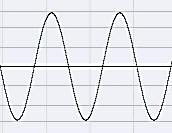
The
signal can be represented graphically like this...
The line through the middle represents zero volts, which is
the same potential as the RCA plug's outer ring and the Ground
(or chassis) of the equipment. The wave shape represents
a sound-wave as positive and negative motion of electrical
current.
|
 |
|
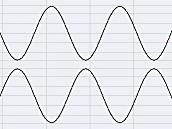
The
same signal in a balanced circuit looks like this...
The signal is not referred to the chassis, instead, it is
referred to its own mirror-image. The music signal is
carried by the difference between the two identical,
but opposite electric currents... as opposed to the difference
between one current and the unit's chassis.
|
 |
|
|
Obviously,
this 'balancing act' will require an extra signal line &
therefore a different plug.
|
|
 |
The
standard connector for balanced lines is the XLR (sometimes
called a "Canon plug") which has two signal pins
plus a shield pin.
Unfortunately, XLRs are quite a bit bigger than RCAs but they're
rugged, reliable and relatively inexpensive.
|
|
|
|
| Pros
and Cons |
|
|
So,
why does this extra line make such a difference? Well,
there are several reasons...
For one, the signal does not 'sit' on the Ground as it does
in an unbalanced circuit -- remember, the Ground is also connected
to the unit's chassis, which is also connected to the Earth
pin of the power plug, so it's also connected by the house-wiring
to your TV, the fridge, the microwave, the computer, the house
next door etc. etc.
As mentioned above, "in a perfect world", the Ground
is meant to represent SILENCE... but the problem is... it
ain't a perfect world!
But the really BIG bonus is a thing called "Common
Mode Rejection" - do read on!
|
|
 |
Common
Mode Rejection is all about how the circuit behaves in the
presence of unwanted signals. Unwanted signals? Consider
this: Every wire is also an antenna for interference and no
shield is ever 100% effective.
Remember, The music signal is carried by the difference
between the two identical, but opposite lines... which implys
that: if there is no difference, there is no signal.
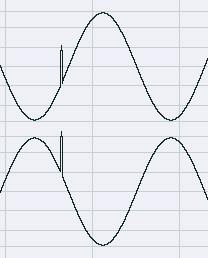
Now, if one line sees some interference, the other one will
too... The graphic on the left shows what happens when
a balanced circuit picks up a 'spike' of interference. As
there is no difference in the spikes, they have virtually
no effect on the signal.
|
|
|
Another
huge bonus that comes from the balanced connection is the
abscence of ground-loops. These are the major cause
of hum in Hi-Fi systems, and probably the most widely mis-understood
and common of problems.
|
|
|
| Ground-Loops
in Unbalanced Systems |
|
|
As
mentioned above, the connection between say, your CD player
and your amp is a circuit because electric currents always
follow a circular path.
The music signal which travels down the centre of the cable
and the outer shield completes the circuit by providing the
return path... or does it?
Electricity ALWAYS follows the line of least resistance --
and we know that the shield that is supposed
to be the return-path for the signal is also connected to
the chassis and the chassis is connected to the Earth pin
of the mains plug.
So...
what happens if the mains cable has less resistance than the
shield of your RCA cable? Well, it becomes part of the
signal path - that's what!
|
|

|
|
The
signal current returns, not via the shield, as it should -
but via the mains cables which are connected together by your
power-board - and in the process, it picks up interference
from the mains, resulting in the noise that we know as HUM.
Because the balanced connection does not rely on the shield
to return the signal current, ground-loops are not a problem.
|
|
| Close
This Window |